
By Lloyd Lalande, PhD
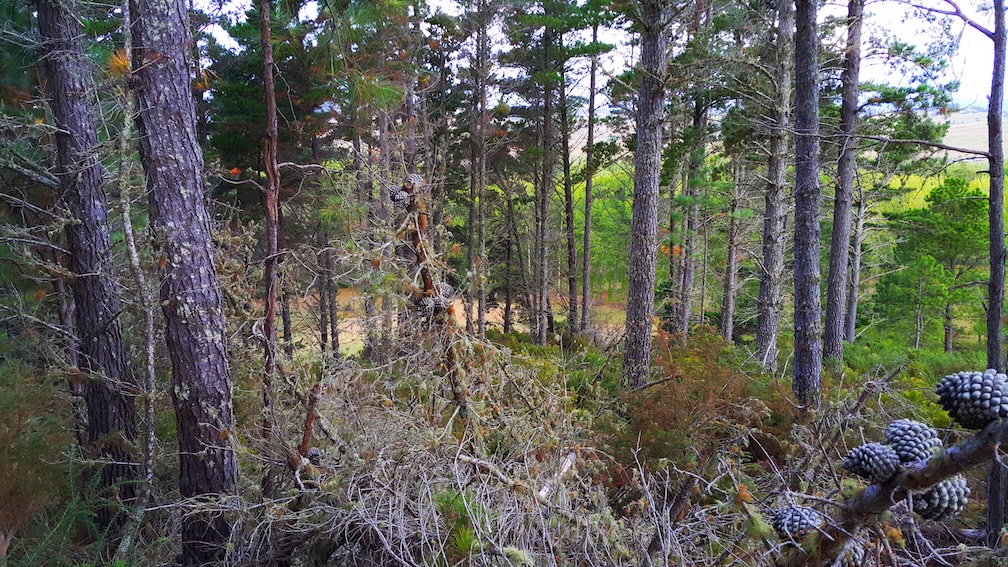
At the beginning of 2020 I stood on an embankment in the Far North of New Zealand looking at distant hills through a forest of old pine trees (pictured above) wondering what to do with them on the block of land I had purchased on-line from Taiwan a few months previous!
Few trees have shaped New Zealand’s land and psyche quite like the Pinus radiata. Imported from California’s Monterey coast in the 1850s, this fast-growing conifer took to NZ’s soils and climate with astonishing success. Within a century it had become our primary timber species — the backbone of a forestry industry that now spans over 1.7 million hectares and underpins billions of dollars in exports.
But our relationship with the pine is not an easy one. For many, vast pine plantations are symbols of ecological loss — dark, uniform blocks replacing native forest, leaving raw scars after harvest. Pine needles are said to acidify the soil, and self-sown “wildings” are viewed as invaders of tussock land and hill country. “Ugly,” “unnatural,” “destructive”: the words come easily in conversations about pine forests.
And yet, travel the length of the country and you’ll see another side of Pinus radiata. Scattered across farmland, on ridgelines and in quiet gullies, are the old shelter belts and self-seeded groves that have long outlived the farms and fences around them. These are not regimented crop trees but great spreading pines — with massive trunks, wide crowns, and a grace that comes from age and wind. They give shape to the rural skyline, cast deep shade for cattle on hot days, and hold their ground through the fiercest winds.
For every New Zealander who sees them as a blight, there’s another who feels something close to affection — a recognition of their endurance and the quiet shelter they’ve given across generations.
The Trouble with Pines
There’s no denying the problems. In commercial forestry, pines are planted densely, often on steep land. When they’re clear-felled 25 to 30 years later, whole slopes can slump and erode before regrowth stabilises the soil. The needle litter beneath them is slow to decompose, creating an acidic surface layer that can suppress some native species.
And wilding pines are a real issue. Blown seed from plantations can colonise high country and native shrublands, shading out indigenous plants and altering fragile ecosystems. The government now spends millions each year on wilding control, from Marlborough to the central plateau.
So yes, radiata pines can dominate — but only when we let them.
The Other Side of the Story
When allowed to grow freely in open country or small groves, Pinus radiata behaves quite differently. Its shade moderates extremes of temperature and wind, reducing soil evaporation. Beneath its branches, grasses and ferns often persist; in time, native seedlings such as kānuka, mānuka, and kawakawa can take root in the sheltered soil.
While the surface beneath mature pines may be slightly more acidic than under pasture, research shows that this effect is modest and reversible once light and litter conditions change. The forest floor under old pines can actually build carbon and humus over decades — a quiet form of soil renewal.
Old shelter-belt pines also serve as stabilisers. Their deep roots anchor erodible slopes, and their dense crowns intercept rain, slowing runoff. Birds use them for roosting and nesting, and in mixed landscapes they often act as windbreaks for orchards, homes, and pasture.
Perhaps most overlooked of all, they offer beauty — that cathedral-like hush beneath their boughs, the resin scent of summer heat, the luminous gold of their needles at sunset.
If the Pines Were Gone
Imagine the rural landscape without those great pines: the hilltop sentinels, the corner shelter belts, the little groves that have become landmarks. The land would look barer, more exposed. Stock would lose shade and wind protection, erosion would quicken on slopes, and the many small habitats that thrive beneath these trees — moss, fungi, insects, and birds — would vanish.
New Zealand’s relationship with Pinus radiata has always been one of tension: economy versus ecology, plantation versus place. But perhaps it’s time for a new view — one that recognises the pine not only as an industrial crop or a pest, but also as a living part of our hybrid landscape.
The truth is, radiata pines are here to stay. They are part of the fabric now — not replacements for our native forests, but contributors to a changing mosaic of land use and life. The challenge is to work with them wisely: to contain their spread, diversify our forests, and celebrate the places where they have become quietly, beautifully at home.
Five Facts About the Radiata Pine
-
Origin: Pinus radiata (Monterey Pine) is native to a small stretch of California’s central coast — a species now far more common in New Zealand than in its homeland where it is endangered.
-
Speed of Growth: In New Zealand’s mild climate and volcanic soils, radiata grows much faster than in California.
-
Economic Powerhouse: Radiata pine makes up over 90% of New Zealand’s plantation forests and timber exports.
-
Wilding Spread: A single mature pine can release up to 17,000 seeds a year, which may travel several kilometres on the wind.
-
Longevity: In plantations, pines are harvested at 25–30 years, but wild or farm pines can live for well over a century, developing massive trunks and spreading crowns.