
by Lloyd Lalande, PhD
Guided Respiration Mindfulness Therapy (GRMT) takes a non-cathartic stance within its one-hour altered-state breathing sessions. This position is not based on moral preference or a dismissal of emotional expression; it rests on a clinical and neuropsychological rationale about how integration actually occurs.
1. Catharsis feels relieving, but does not reliably integrate underlying material
Many somatic and expressive breathwork traditions—e.g., holotropic breathwork—value cathartic discharge as a primary therapeutic mechanism. However, decades of psychotherapy research show:
-
Emotional release reduces immediate distress
-
But it does not reliably alter core patterns
-
In some cases, it strengthens emotional reactivity through rehearsal of arousal states
-
And it can become a secondary dissociation: a bypass of subtle emotional layers - a "running away" rather than "staying with"
This aligns with the broader findings in trauma therapy:
High-intensity discharge often produces temporary relief but low retention of insights, poor transfer to daily life, and limited integration at the level of somatically stored trauma and implicit memory.
GRMT emphasises that relief is not the same as effective, efficient resolution - the secret is in the subtlety
2. GRMT’s non-cathartic stance supports “staying with” the dominant sensation
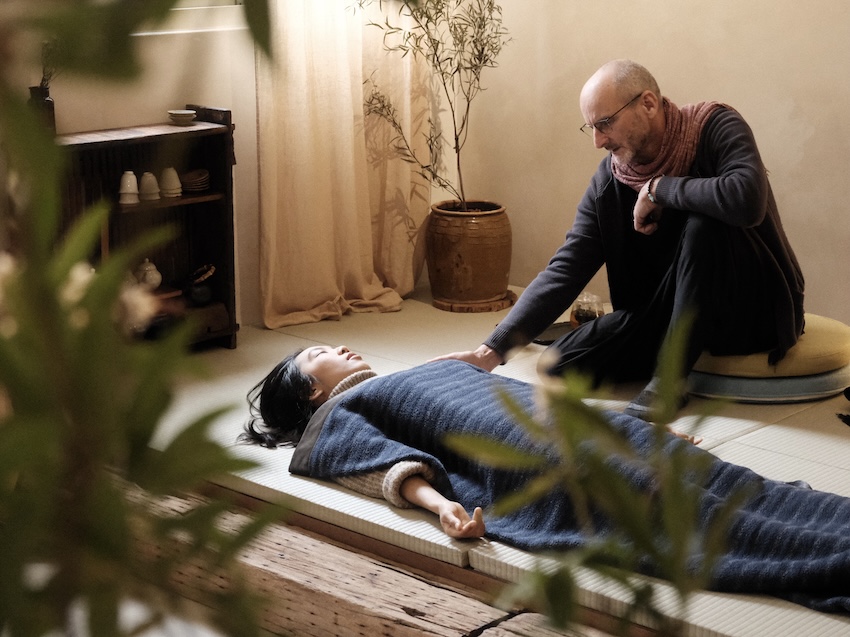
By focusing on the strongest bodily sensation, and observing it until it naturally subsides, GRMT draws on principles from:
-
Mindfulness meditation and Buddhist contemplative practices
-
Sensory tracking
-
Somatic experiencing (without the discharge focus)
-
Interoceptive exposure therapy
-
Predictive processing and active inference models
Key mechanism:
When the nervous system stays with a sensation long enough for it to self-organise into a new state, integration occurs without reinforcing the emotional loop that created it.
In other words, the client learns:
“This can rise, exist, and dissolve without me acting it out.”
That experience is profoundly reorganising for the brain.
3. Catharsis can disrupt the delicate conditions needed for neural consolidation
Altered-state breathwork opens a brief window where implicit material—emotional, sensory, and memory-based—becomes malleable. During this window, the nervous system is in a high-learning state.
But high arousal (crying, shouting, thrashing) pushes the system into:
-
Sympathetic dominance
-
Top-down loss of reflective awareness
-
Reduced capacity to form coherent implicit–explicit links
-
Fragmentation rather than synthesis
-
Working-memory collapse (making meaning harder)
GRMT prioritises integration over intensity.
It protects the reflective capacity needed for consolidation.
Think of the one-hour session as a container where the psyche presents material, and mindfulness allows it to rewire.
Catharsis may feel powerful but can “kick the ladder out” from under the integrative process.
4. Mindful observation activates different neural circuits from cathartic action
Catharsis → motor discharge pathways
Mindful observation → interoceptive networks + prefrontal modulation
This shift matters:
-
Observing a sensation strengthens the insula–prefrontal loop (interoception + regulation).
-
Acting out a sensation reinforces the amygdala–motor loop (arousal + discharge).
GRMT’s aim is to strengthen the regulatory network, not the reactivity network.
This is why GRMT sees catharsis as non-productive for integration.
It strengthens the wrong circuits.
5. The non-cathartic stance promotes “completion through precision,” not through force
GRMT’s method treats the body’s arising sensations as emergent signals, not blockages to be broken through.
The process:
-
A dominant sensation appears (tightness, heat, trembling, pressure, even pain).
-
Attention rests on it with patience and curiosity.
-
The sensation unfolds and resolves in its own trajectory.
-
Another sensation becomes dominant, repeating the cycle.
This teaches the nervous system a new set of rules:
-
Emotions can complete themselves without outburst.
-
Painful or intense sensations contain intelligence.
-
Integration is a sequence of subtle reorganisations, not eruptions.
This promotes long-term stability, self-trust, and post-session coherence.
6. Contrast with catharsis-based breathwork: different goals, different outcomes
Holotropic and similar approaches pursue:
-
emotional peak experiences
-
dramatic release
-
symbolic reenactment
-
transpersonal breakthrough
GRMT pursues:
-
integration
-
precision of sensation
-
subtlety of awareness
-
continuity of consciousness
-
reinforcement of regulatory pathways
-
consolidation of new neural patterns
The difference is not merely stylistic; it is methodological and philosophical.
Catharsis produces an event.
GRMT produces a shift.
7. The non-cathartic stance creates conditions for post-session integration
Since GRMT culminates in what I call Neural Transition Support (NTS), the session must preserve:
-
coherent awareness
-
access to the integrative state
-
stable interoception
-
a sense of internal authorship over the experience
Catharsis disrupts these conditions.
The mindful, non-expressive stance preserves them.
Thus:
GRMT session → integrative window → NTS consolidation → durable change
Catharsis-based methods often skip the integrative window altogether.